
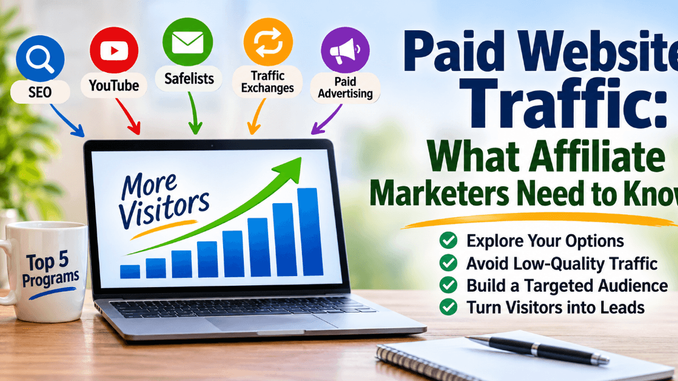
Updated November 27, 2026: This article has been extensively revised to reflect today’s online marketing landscape. Rather than focusing on buying bulk website traffic, it now explores the different ways affiliate marketers can attract visitors, including paid advertising, SEO, YouTube, safelists and traffic exchanges, with an emphasis on traffic quality, lead generation and building a sustainable online business.
Getting visitors to your website is one of the biggest challenges in affiliate marketing. You can have a great website, carefully written articles and some excellent affiliate offers, but without visitors, none of those things will do much for your business.
Search engine optimisation (SEO) is an important part of building long-term website traffic, but it isn’t the only option. There are plenty of other ways to attract visitors, including paid advertising, traffic exchanges, safelists and specialist traffic services.
However, not all traffic is created equal. The important thing isn’t simply how many visitors you can send to a website. It’s whether those visitors are relevant to your offer and whether they are likely to take the next step.
In this article, I’ll look at the different ways affiliate marketers can generate website traffic, what to watch out for when paying for visitors, and how to make better use of the traffic you receive.
What Is Paid Website Traffic?
Paid website traffic is simply traffic that you acquire by paying another platform or service to send visitors to your website.
This can take several forms:
- Search advertising: Paying to display advertisements when people search for particular keywords.
- Social media advertising: Promoting your website or landing pages to selected audiences on platforms such as Facebook and YouTube.
- Display advertising: Paying for banner advertisements or other placements on relevant websites.
- Sponsored placements: Paying publishers or website owners to feature your content or offers.
- Traffic services: Using specialist services that distribute your website links through their advertising networks.
These approaches are quite different from one another, and the quality of the traffic can vary considerably.
For example, someone who clicks a Google advertisement after searching for a particular product may have a specific interest in buying it. Someone who visits your website because they clicked a link to earn credits on a traffic exchange may have a very different motivation.
Both count as visitors, but you shouldn’t expect them to behave in the same way.
Is Buying Website Traffic Worth It?
It can be, but I would be cautious about buying traffic simply because a service promises thousands of visitors for a relatively small amount of money.
A large visitor count looks impressive in your website statistics, but it doesn’t necessarily translate into subscribers, sales or affiliate commissions.
Before spending money, consider what you actually want to achieve.
Are you looking for:
- More visitors to your blog?
- Subscribers for your email list?
- People interested in a particular product?
- Potential customers for an affiliate offer?
- Exposure for a new website or landing page?
These are different objectives, and they require different approaches.
For most affiliate marketers, I would prioritise generating leads rather than simply increasing visitor numbers. Someone who subscribes to your mailing list gives you an opportunity to build a relationship and introduce them to relevant products over time.
That’s generally more valuable than a visitor who arrives, looks at your page for a few seconds and disappears.
How to Avoid Low-Quality Website Traffic
One of the biggest risks when purchasing website traffic is paying for visitors who have little or no genuine interest in what you’re promoting.
Some services deliver automated bot traffic, while others rely on incentivised visitors or advertising placements that generate very little engagement.
Here are a few things I would check before using any traffic provider.
1. Understand where the visitors come from
A reputable provider should be able to explain how its traffic is generated. Are visitors coming from advertising placements, search-related campaigns, partner websites or an incentivised network?
If the provider cannot give you a reasonable explanation, I’d be reluctant to spend money.
2. Don’t rely on visitor numbers alone
A service promising 10,000 visitors isn’t necessarily better than one delivering 500 relevant visitors.
Look at the quality of the visits, including time spent on your website, pages viewed, returning visitors and, most importantly, conversions.
3. Start with a small test
Never commit a large advertising budget to an unfamiliar traffic source.
Test a small campaign first. Track the results and see whether visitors are doing anything useful once they arrive.
4. Be wary of guaranteed results
No genuine traffic provider can guarantee that a particular number of visitors will become subscribers or customers. Traffic delivery and conversion performance are two different things.
5. Use proper tracking
Make sure you can identify where your visitors are coming from. Tracking links, analytics and landing-page statistics will help you compare different traffic sources and decide which ones are worth continuing with.
Free and Low-Cost Traffic Sources for Affiliate Marketers
Buying advertising isn’t the only way to get visitors. In fact, there are several traffic generation methods that can be particularly useful when you’re starting an online business or working with a limited budget.
Search Engine Traffic
Search engine traffic remains one of the most valuable long-term sources of visitors.
When someone searches Google for information about a product, service or problem, they are actively looking for something. If your website provides a useful answer, you have an opportunity to attract that visitor.
The downside is that SEO takes time. Publishing helpful articles, building your website’s authority and earning search visibility are ongoing activities rather than quick fixes.
YouTube
YouTube is another excellent source of free traffic.
You don’t necessarily need expensive equipment or a professional recording studio. You can create useful videos explaining products, demonstrating software, answering questions or sharing your experience with different online business tools.
You can then direct viewers to relevant articles, landing pages or affiliate offers.
One advantage of YouTube is that videos can continue attracting visitors long after publication. A useful tutorial can generate traffic for months or even years.
Safelists
Safelists are email marketing communities where members view advertisements or emails in exchange for credits. Those credits can then be used to send your own promotional messages to other members.
They are particularly popular in the internet marketing and home business niches.
The main advantage is that you can promote your offers without paying for every mailing. The disadvantage is that members receive a lot of promotional emails, so getting their attention isn’t always easy.
I use safelists as part of my own traffic generation strategy, particularly for promoting lead magnets and building my mailing lists.
One tool I recommend for this type of marketing is Traffic Zipper. It automates safelist mailing campaigns, saving considerable time when you’re working with several different mailers.
Traffic Exchanges
Traffic exchanges work on a similar principle, except members visit one another’s websites to earn credits.
You earn credits by viewing other members’ pages, and then spend those credits to have your own pages displayed.
Traffic exchanges can be useful for getting exposure, testing landing pages and introducing your offers to other online marketers.
However, it’s important to understand the nature of the traffic. Someone viewing your page to earn credits isn’t necessarily interested in buying anything.
I wouldn’t treat traffic exchanges as a substitute for targeted search traffic or paid advertising. They are simply another tool that can form part of a wider traffic generation strategy.
If you’re interested in learning how to use this approach, I’ve also put together resources on traffic exchange marketing and list building.
Why Your Landing Page Matters
Whatever traffic source you use, the page visitors arrive at can make a significant difference to your results.
Sending people directly to a complicated sales page isn’t always the best approach, particularly if they have never heard of you before.
For affiliate marketers, a simple opt-in page offering something useful in exchange for an email address can be a better starting point.
This might be:
- A free ebook or report.
- A checklist or quick-start guide.
- A useful tutorial.
- Access to a training resource.
- A free course or series of lessons.
Once someone joins your mailing list, you can follow up with useful information and introduce relevant products and services.
This gives you an opportunity to develop a relationship rather than relying on a single website visit to generate a commission.
Of course, your landing page needs to deliver what it promises. A visitor who signs up for a free report should receive that report without unnecessary complications.
Tracking Your Traffic and Measuring Results
One mistake I see affiliate marketers make is concentrating too much on the number of visitors they receive.
Traffic statistics are useful, but they don’t tell the whole story.
You should also be measuring:
- How many visitors arrive at your landing page.
- How many unique visitors click through.
- How many people subscribe to your list.
- Which traffic sources produce the most subscribers.
- Whether those subscribers eventually generate sales.
This is where having the right tools makes a difference.
LeadsLeap is one of my favourite online marketing platforms because it combines several useful tools in one place.
It includes a page builder, link tracking, pop-up creation and SendSteed, its built-in autoresponder.
You can create opt-in pages, capture leads, build email follow-up sequences and monitor the performance of your campaigns without having to piece together several separate services.
I’ve been using LeadsLeap since 2008, and it has remained one of my Top 5 Programs since I launched this website in 2017.
My Approach to Generating Website Traffic
Over the years, I’ve experimented with quite a few different traffic generation methods. Some have worked better than others, but I’ve come to the conclusion that relying on a single source of visitors is rarely a good strategy.
My preference is to combine several approaches.
I use content marketing and YouTube to build a longer-term presence and attract people who are genuinely interested in online business.
I also use safelists and traffic exchanges to get additional exposure for my websites and landing pages. Tools such as Traffic Zipper help automate some of that work, making it easier to maintain regular promotional activity.
Finally, I use LeadsLeap to build landing pages, capture subscribers and track the results.
The important thing is to give each traffic source a purpose. Not every visitor is going to become a customer, and not every traffic method will produce the same results.
Rather than chasing ever-larger visitor numbers, I prefer to concentrate on building a system that consistently attracts people, captures leads and gives me opportunities to generate income over time.
Final Thoughts
Getting traffic to your website is an essential part of affiliate marketing, but buying bulk website traffic isn’t necessarily the answer.
Paid advertising can be useful when you know your audience, understand your costs and have a way of measuring conversions. Meanwhile, free and low-cost methods such as SEO, YouTube, safelists and traffic exchanges can all play a role in building your online presence.
My advice is to experiment, track your results and concentrate on the traffic sources that bring you the best prospects.
Remember, 100 genuinely interested visitors can be far more valuable than 10,000 visitors who have no particular reason to be on your website.
And ultimately, that’s what successful traffic generation is all about.