
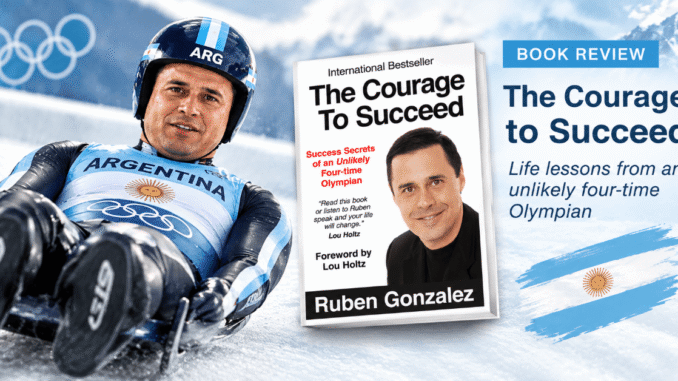
Updated October 2026: Originally published on this blog in 2017, this article has been updated as a review of Ruben Gonzalez’s book, The Courage to Succeed: Success Secrets of an Unlikely Four-Time Olympian. I first encountered Ruben’s motivational message in 2009, and his story helped me stay focused on building my own online business. In this updated review, I revisit the lessons behind his remarkable Olympic journey and consider how they apply to anyone working towards a long-term goal.
Some books stay with you because they introduce an entirely new idea. Others stay with you because they remind you of something you already know but need to hear again.
The Courage to Succeed: Success Secrets of an Unlikely Four-Time Olympian by Ruben Gonzalez falls into the second category for me. It is a book about ambition, self-belief and persistence, built around the remarkable story of a man who pursued an Olympic dream despite having very little reason to believe he would achieve it.
I first discovered Ruben Gonzalez through a DVD of one of his motivational speeches back in 2009. His story made a strong impression on me and helped keep me going as I worked towards my own goal of building a successful online affiliate marketing business.
Having been inspired by his message, I wanted to explore the book behind it in more detail.
Who Is Ruben Gonzalez?
Ruben Gonzalez is an Argentinian luge competitor who achieved something remarkable by competing in four Winter Olympic Games across four different decades.
His Olympic appearances were in Calgary in 1988, Albertville in 1992, Salt Lake City in 2002 and Vancouver in 2010. He was 47 when he competed in Vancouver.
What makes his story particularly interesting is that Ruben wasn’t a naturally gifted athlete who had spent his childhood preparing for an Olympic career. He describes himself as an ordinary person who had struggled with sport at school and was often among the last to be chosen for a team.
He took up luge at the age of 21, an unusually late start for a sport in which many competitors begin training as children.
Yet he went on to compete against some of the best lugers in the world.
How did he do it?
That question lies at the heart of The Courage to Succeed.
What Is The Courage to Succeed About?
The book is divided into four main parts. Ruben begins by telling the story of his unlikely journey towards the Olympics, then develops the principles he believes helped him succeed. Later sections explore further examples of success, before bringing the ideas together in a discussion of how we can apply them to our own lives.
Rather than simply recounting his sporting achievements, Ruben uses his experiences to explain how ordinary people can pursue ambitious goals.
Several themes run throughout the book.
1. Believe in the Possibility of Success
Ruben’s Olympic dream was born when he watched the famous American ice hockey team’s unexpected victory over the Soviet Union at the 1980 Winter Olympics in Lake Placid.
The result helped him reconsider what might be possible. Four years later, he went to Lake Placid himself, determined to begin training for the Calgary Olympics.
The important point isn’t that believing in something guarantees success. It’s that without believing a goal is possible, we may never take the first step.
This is especially relevant when you’re starting something unfamiliar. Other people may think your plans are unrealistic, and you may have doubts of your own. But if you allow those doubts to make every decision for you, you’ll never discover what you might have achieved.
Ruben encourages readers to examine the beliefs that hold them back and to learn from people who have accomplished things they would like to achieve themselves.
2. Learn to Act Despite Fear
The title of the book is particularly appropriate because Ruben makes it clear that courage doesn’t mean being free from fear.
Luge is a dangerous sport. Competitors hurtle down an icy track at extraordinary speeds, making constant adjustments to their sleds while trying to maintain control. Ruben describes the fear he experienced during his training and the temptation to give up after a difficult run.
His response was not to wait until he felt completely comfortable. He learned to keep going despite his fear.
There is an important distinction here. Courage isn’t recklessness, and Ruben also discusses managing risk. The lesson is to recognise the risks involved, prepare as well as possible and then have the courage to act.
In business, the risks are usually very different from those faced by a luger. Nevertheless, starting a business, publishing your first video or putting your work in front of an audience can all feel uncomfortable when you’re unsure of the outcome.
You don’t have to eliminate that uncertainty before you begin.
3. Keep Going When Progress Is Slow
One of the most memorable aspects of Ruben’s story is the relationship he developed with his coach, Günther Lemmerer.
After a difficult run, Ruben might feel discouraged and want to quit. His coach would give him specific feedback about what needed to improve, helping him refocus on his long-term objective rather than dwelling on the latest disappointment.
Ruben explains how important it was to have someone who believed in him, particularly during periods when he struggled to believe in himself.
This is a practical lesson for anyone pursuing a long-term goal. There will be days when your results don’t justify the effort you’ve put in. Sometimes, you need to adjust your approach. At other times, you simply need more experience and practice.
Having a mentor, coach or trusted friend who can offer an outside perspective can make a real difference.
The book also encourages readers to study successful people, including through biographies, and to learn from their experiences rather than assuming that every challenge must be solved from scratch.
4. Turn Big Dreams into Practical Plans
Motivation can help you get started, but motivation alone won’t carry you all the way to your destination.
Ruben devotes considerable attention to identifying your dream, setting goals, developing a game plan and conditioning your mind to support your ambitions.
The underlying message is that an ambitious goal becomes more manageable when you break it down into actions you can take today.
You might have a dream of becoming financially independent, running your own business or developing a new skill. Those are long-term ambitions, but you still need to decide what to do this week, what to practise and how to measure your progress.
I particularly like the emphasis on taking responsibility for your own decisions. Other people can offer advice and encouragement, but ultimately you have to put the plan into action yourself.
What Can Online Entrepreneurs Learn from This Book?
This is where Ruben’s message connects directly with my own experience.
I’ve been involved in online business for many years, including affiliate marketing, and one of the biggest challenges is maintaining momentum when the results aren’t what you expected.
It’s easy to become distracted by a new opportunity, abandon a project too early or spend more time looking for a better strategy than putting the strategy you already have into practice.
Ruben’s story is a useful reminder that meaningful progress often requires a clear focus and sustained effort over a long period of time.
Building an online business involves learning new skills, publishing content, reaching potential customers and working out what needs to change when something isn’t producing results. There are no guarantees, and persistence doesn’t mean repeating the same mistakes indefinitely.
The most useful approach is to keep your longer-term objective in view while remaining willing to learn, seek advice and adjust your methods.
That is one reason Ruben’s story resonated with me when I first encountered his speaking material. It reminded me that success isn’t reserved for people who start with every advantage. What you do with the opportunities and abilities you have matters enormously.
What I Liked About The Courage to Succeed
The strongest part of the book is Ruben’s personal story. His account of taking up a demanding sport relatively late in life, enduring injuries and continuing to work towards his Olympic goal gives the advice a foundation in lived experience.

He isn’t simply telling readers to be persistent. He explains what persistence looked like in his own life, including the moments when he wanted to quit.
I also appreciate the book’s emphasis on learning from other people. Self-belief is important, but so is recognising when you need guidance, feedback or encouragement. Ruben’s relationship with his coach illustrates how these things can work together.
Another positive is the book’s practical orientation. Its chapters cover subjects such as discovering your purpose, setting goals, managing risk, turning defeat into victory and building a team. Readers can use these ideas to examine their own ambitions rather than simply enjoying an inspiring story and moving on.
One thing to be aware of is that the book is firmly in the traditional motivational genre. Ruben returns to certain principles repeatedly, particularly the importance of belief, commitment and refusing to give up. Readers who prefer a tightly argued, research-heavy treatment of success may find this style repetitive.
However, Ruben is deliberately trying to reinforce ideas that he wants readers to put into practice. He even recommends rereading useful material, making notes and applying selected lessons rather than merely finishing the book.
For me, that is a reasonable approach to a book intended to encourage action.
Is The Courage to Succeed Worth Reading?
If you enjoy motivational books, biographies of determined individuals or practical advice on pursuing ambitious goals, I think The Courage to Succeed is worth considering.
You don’t have to be an athlete to appreciate Ruben’s story. The principles he discusses can be applied to business, education, personal development and many other areas of life.
I would particularly recommend it to anyone who has a worthwhile goal but has begun to doubt whether they can achieve it. Ruben’s experiences offer a useful reminder that the first obstacle isn’t always a lack of ability. Sometimes it’s the assumption that we’re not capable of doing something before we’ve given ourselves a genuine opportunity to try.
The book won’t provide a guaranteed formula for success, and reading it won’t do the work for you. Its value lies in the encouragement and practical principles it offers, provided you’re prepared to put them into action.
Final Thoughts
What I take away from Ruben Gonzalez’s story is that you don’t need to be the most talented person in the room to pursue something worthwhile.
You need a goal that matters to you, a willingness to learn, the courage to take action and enough persistence to work through the inevitable setbacks. You also need the judgement to recognise when a change of approach or some help from others would serve you better.
Those lessons have relevance far beyond the Olympic track.
When I first encountered Ruben’s story, I was working towards my own ambitions in online business. His message helped reinforce the importance of continuing to work towards those ambitions, even when the journey wasn’t straightforward.
That’s why I wanted to revisit his work and why I believe The Courage to Succeed still has something to offer readers who are serious about their own goals.
Chase your dream and make your life an adventure.
That’s a fitting message from Ruben Gonzalez, and a good principle to keep in mind whether you’re building a business, developing a skill or working towards a personal ambition.
Book: The Courage to Succeed: Success Secrets of an Unlikely Four-Time Olympian
Author: Ruben Gonzalez
