
Updated October 2026: This article was originally published in 2017. I’ve refreshed the advice, updated references to the tools I use today, and replaced a discontinued marketing funnel with my current Beginner’s Guide to the Prosperity Marketing System.
Are you struggling to make your online business successful? Perhaps you’re finding it difficult to generate meaningful income, despite spending time and money trying different programs.
When you fail to make money with one program, do you jump into another, then another, and another? If you’re program hopping in search of the magic solution that will solve all your problems, STOP right now!
I’ve been involved in online business for more than 20 years, and one lesson I’ve learnt is that success depends on more than finding the right program. You need a plan, suitable tools, a way to attract and follow up with prospects, and the patience to improve your results.
Here are five practical steps to help you build a more sustainable online business.
But Before That… Here Are 3 Common Mistakes You Must Avoid
Mistake #1: Reinventing the Wheel
While it’s important to differentiate yourself and your offering, there are certain things you don’t need to build from scratch.
Don’t spend months developing systems that already exist. Find out what’s working, learn how to use the available tools, and concentrate your effort on the parts of your business that need your personal input.
For example, you don’t need to subscribe to a standalone tracking service when LeadsLeap already provides tools to track clicks and measure the performance of your marketing.
The trick is to use existing tools intelligently while developing your own approach to marketing.
Mistake #2: Proceeding Without a Plan
A business plan doesn’t have to be complicated, but you need to know what you’re trying to achieve.
Without a plan, it’s easy to spend your time chasing opportunities that don’t fit together. You might buy a new product, join another affiliate program, or start a website without having any clear idea of how these activities will contribute to your business.
Start with a simple plan. Decide who you want to reach, what you want to offer them, how you’ll attract visitors, and what you want those visitors to do next.
You can refine the details as you learn more about your market.
Mistake #3: Analysis Paralysis
Research is important, but it’s possible to spend so much time analysing opportunities that you never get around to doing anything.
You could spend weeks comparing website hosts, autoresponders, traffic services and affiliate programs. Meanwhile, somebody else with a perfectly workable setup is publishing content, building a list and learning from real results.
You don’t need everything to be perfect before you begin.
Make a sensible decision, take action, and improve your approach as you gain experience. Progress comes from doing the work, measuring what happens and making adjustments.
So, let’s get moving with the five steps.
How To Make Your Online Business Successful
Step #1: Build a Basic Business Plan
A business plan doesn’t need to be complex to be effective. A clear description of what you want to achieve, how you’ll work towards it and when you’ll review your progress is a good starting point.
Begin by identifying your intended audience. Who are these people? What are they trying to achieve? What problems are they experiencing, and how can your business help them?
For an affiliate marketer, this means choosing programs and products that are relevant to the people you’re trying to reach.
It also means thinking beyond the commission. If you recommend a product that doesn’t meet your audience’s needs, you may make a sale, but you’re unlikely to build much trust or encourage people to return.
Next, decide how you’ll reach your audience. Will you publish articles on a blog, make YouTube videos, build an email list, use paid advertising, or promote your content through traffic exchanges and safelists?
You don’t have to use every available method. In fact, starting with a manageable number of activities is often a better idea.
Set realistic targets for the work you can control. For example, you might aim to publish two useful articles a month, create regular videos, or add a certain number of subscribers to your list.
You can’t guarantee how many visitors, subscribers or sales you’ll get, but you can control how consistently you work towards your goals.
Step #2: Copy, Adapt and Test
Successful marketers pay attention to what works.
That doesn’t mean copying somebody else’s content word for word or pretending that another person’s business is your own. It means studying successful approaches, understanding why they work, and adapting the underlying ideas to suit your audience.
Look at how established marketers introduce their products, structure their websites, build email lists and follow up with subscribers. Consider what you can learn from their methods.
Then test your own approach.
For example, you might experiment with two different headlines, compare the response to different lead magnets, or try alternative ways of introducing an affiliate offer.
The important thing is to measure the results rather than relying entirely on your own assumptions.
If one headline attracts more clicks, investigate why. If a particular article brings visitors to your website but few of them subscribe, look at whether the offer is relevant and whether the next step is clear.
Don’t change everything at once. Make manageable adjustments so you can identify which changes are helping.
You can also use AI tools to help brainstorm content ideas, organise research, improve a draft or explore alternative headlines. However, the final content should reflect your own experience and provide genuine value to the people you’re trying to reach.
The goal isn’t to produce more marketing material simply for the sake of it. It’s to discover what helps you connect with your audience and move your business forward.
Step #3: Use the Right Tools
In another blog post I shared the story of how problems with a cheap web host contributed to the loss of my previous online business blog. That experience taught me to take the reliability of my business infrastructure seriously.
Today, I host my WordPress blogs through Wealthy Affiliate, which also provides training and resources for people building online businesses.
The right tools depend on what you’re trying to accomplish. A blogger needs a reliable website, while an affiliate marketer may also need an email marketing service, a way to track clicks, and a process for capturing leads.
You don’t necessarily need the most expensive tools, nor do you need to sign up for every service that catches your attention.
Choose tools that serve a clear purpose, understand their limitations, and review them periodically to make sure they’re still suitable for your business.
Here are some of the areas worth considering:
- Website and hosting: A reliable website gives you a place to publish useful content and build an online presence you control.
- Email marketing: An email list gives you a way to communicate with subscribers who have asked to hear from you.
- Tracking: Knowing which links and campaigns generate clicks, subscribers and sales helps you make better decisions.
- Content creation: A blog and video channel can attract people who are researching topics related to the products you promote.
- Traffic generation: Different methods suit different audiences. Choose the ones that are most likely to reach the people you want to attract.
My own approach is to keep things relatively simple. I want the tools I use to support my marketing activities, not become a never-ending project in themselves.
Step #4: Build a Marketing Funnel
Getting visitors to your website is only part of the job. You also need a way to turn some of those visitors into prospects you can follow up with.
That’s where a marketing funnel comes in.
A marketing funnel is a process that takes people from discovering your business to learning more about what you offer. It might begin with a blog post, a YouTube video, an advert or a link in a newsletter.
From there, you can invite visitors to subscribe to your email list in exchange for something useful, such as a free guide. You can then send follow-up emails that provide further information and introduce relevant products or services.
I’ve built a funnel around the Prosperity Marketing System (PMS) using this approach.
The funnel offers visitors my free Beginner’s Guide to the Prosperity Marketing System. The guide introduces the system, explains how the membership options work, outlines its commission structure and describes how to get started.
Rather than sending visitors straight to an affiliate offer, I give them an opportunity to learn about PMS first. When they subscribe, they receive the guide by email and can then receive follow-up messages introducing the opportunity in more detail.
You can get the free guide here:
Get the Beginner’s Guide to the Prosperity Marketing System
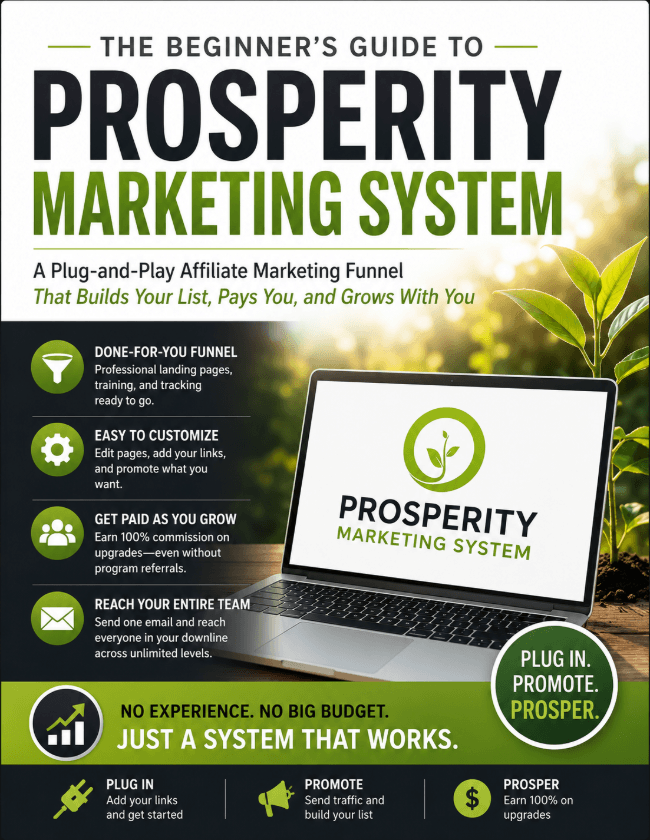
This is one example of how a simple funnel can connect traffic generation, list building and affiliate marketing.
Of course, having a funnel doesn’t automatically produce sales. You still need to attract the right audience, provide a useful reason for people to subscribe, and make sure your follow-up messages are relevant.
You also need to monitor the results. If people click your link but don’t subscribe, you may need to review the capture page, the traffic source or the promise you’re making. If subscribers join but don’t engage with your emails, consider whether the messages are meeting their expectations.
A funnel gives you a process you can measure and improve. Over time, that can make your marketing more organised and give you more opportunities to build relationships with potential customers.
Step #5: Understand the Power of Patience and Persistence
Let’s be realistic. Most online businesses don’t become successful overnight.
You may publish an excellent article that attracts very little traffic at first. You might send visitors to a capture page and find that few of them subscribe. An email campaign may generate clicks without producing any sales.
These things happen.
The important question is what you do next.
If you’ve tracked your results, you have something to work with. You can investigate where people are dropping out of the process, reconsider your offer, improve your content or try a different source of traffic.
Persistence doesn’t mean repeating the same actions indefinitely and hoping for a different outcome. It means continuing to work while learning from the results.
Patience doesn’t mean waiting passively for success, either. It means allowing enough time for your efforts to produce meaningful information, while remaining willing to change your approach when the evidence suggests you should.
Give your website time to develop an audience. Build your email list gradually. Keep publishing useful content, and pay attention to which topics attract the right visitors.
If something isn’t working, don’t be afraid to make changes. Equally, don’t abandon a promising approach just because it hasn’t produced immediate results.
The market’s response to your offer will help determine how quickly you make progress. Your job is to keep learning, improving and making informed decisions.
Simple Is the New Sophisticated
It’s easy to become distracted by flashy products, complicated marketing systems and promises of quick results.
But you don’t need an elaborate business structure to get started. You need a clear plan, useful tools, a way to reach your audience, and a process for turning interested visitors into prospects.
You also need to keep track of what you’re doing and be prepared to improve it.
Here’s the simple formula I’d suggest:
Plan your work. Take action. Measure your results. Make improvements. Be patient and persistent.
It’s straightforward, but putting it into practice consistently is another matter.
If you’re currently jumping from one program to another, take a step back. Choose an approach that fits your goals, learn how to use it properly, and give yourself time to develop a working business process.
You don’t need to do everything at once. You just need to make sensible progress, one step at a time.