
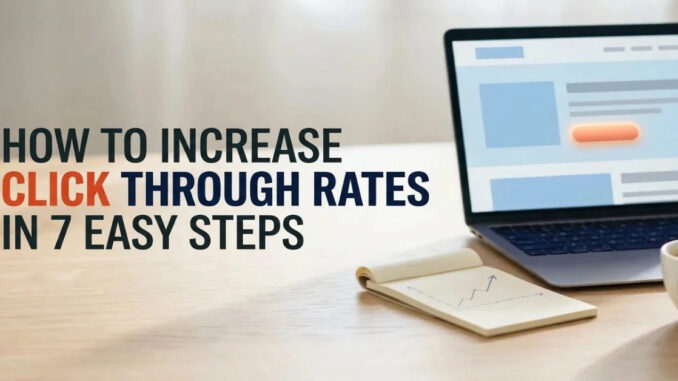
Updated October 2026: This article has been revised to reflect current online marketing practices, with updated advice on improving click-through rates across advertising, email marketing and social media campaigns.
Are you running an online advertising campaign, sending emails to your list, or promoting affiliate offers on social media? If so, you probably want to know how to increase click through rates and get more people to take a closer look at what you are promoting.
There is plenty of advice available about writing attention-grabbing headlines, creating compelling calls to action and giving people a reason to act. All of these techniques can help, but successful marketing requires more than simply getting someone’s attention.
You need to reach the right audience, give people a reason to be interested in your offer and make it easy for them to take the next step.
Here are seven practical ways to increase click through rates in your online advertising, email marketing, social media campaigns and blog posts.
How To Increase Click Through Rates For Your Online Ad Campaigns
1. Write A Headline That Promises A Clear Benefit
Your headline is often the first thing people notice when they see an advertisement, an email or a social media post. If it fails to attract their attention, the rest of your message may never get read.
One way to improve your headlines is to focus on a benefit that matters to your target audience. Rather than simply announcing a product or service, explain what someone could gain from taking a closer look.
For example, compare these two headlines:
- Discover Our New Email Marketing Tool
- How To Build Your Email List Without Spending A Fortune On Advertising
The second headline identifies a specific interest and gives the reader a reason to find out more. Of course, your content must deliver on the promise you make.
You don’t need to resort to exaggerated claims or sensational headlines. A clear, relevant benefit is often enough to make your message stand out.
2. Focus On A Problem Your Audience Wants To Solve
One of the most effective ways to attract attention is to address a problem that your audience is already trying to solve.
People search online for solutions to problems every day. They want to get more website traffic, build an email list, improve their marketing results or find a better way to manage their online business.
If your advertisement speaks directly to one of these needs, it gives people a reason to click.
For example, this article targets the phrase how to increase click through rates. Someone searching for that phrase is likely to be interested in improving the performance of their advertising or marketing campaigns.
The same principle applies when promoting a blog post through email or social media. Instead of simply sharing the title, explain the problem the article addresses and give people a reason to read it.
The more closely your message matches what your audience wants to achieve, the more likely you are to attract relevant clicks.
3. Make Your Offer Relevant And Worth Clicking
Free offers can be an effective way to attract attention, particularly when you want to build an email list. However, simply describing something as free doesn’t automatically make it appealing.
People have become accustomed to seeing free reports, ebooks, training courses and other lead magnets advertised online. Your offer needs to give them a reason to choose yours rather than ignore it and move on.
The key is relevance.
If your target audience consists of affiliate marketers who struggle to generate traffic, a practical guide to getting more visitors to their websites is likely to be more appealing than a general ebook about making money online.
A useful free resource can also provide a natural introduction to a paid product or service. Someone who downloads a guide to building an email list, for example, may subsequently be interested in email marketing tools or training.
Think about the specific problem your audience wants to solve, then make sure your offer provides a worthwhile first step towards solving it.
4. Build Credibility With Genuine Proof
Online marketers sometimes make claims that sound impressive but provide little evidence to support them. Unsurprisingly, this can make potential customers reluctant to click.
If people are unsure whether an offer is legitimate or whether it can deliver the promised benefits, they may simply move on to something else.
Genuine testimonials, customer reviews and verifiable results can help address these concerns.
For example, if you are promoting a product that has helped customers achieve a particular result, a relevant testimonial may give potential buyers a better understanding of its benefits. A demonstration or screenshot can also be useful when it shows what a product actually does.
The important thing is to use evidence that is genuine and relevant to the claim you are making. Don’t invent testimonials, exaggerate results or suggest that exceptional outcomes are typical when you have no evidence to support that claim.
You should also consider whether the person providing a testimonial has given permission for it to be used.
Credibility is particularly important in affiliate marketing, where people may be unfamiliar with the products you recommend. Being honest about what you have used, what you have experienced and what readers can reasonably expect can help build trust over time.
5. Use Images That Support Your Message
Images can make an advertisement or social media post more noticeable, but they work best when they reinforce the message rather than simply decorate it.
If you are promoting a physical product, a clear product image may help people understand what you are offering. If you are advertising software, a screenshot can show the interface or demonstrate a useful feature. For a training course, an image might illustrate the subject being taught.
Comparisons can be particularly effective when they demonstrate a genuine difference. Before-and-after photographs, for example, may help illustrate a result when they are authentic, appropriately presented and not misleading. The same idea can be applied to website improvements, product demonstrations and other measurable changes.
Choose images that make sense for the offer and the audience. An attractive image that has little connection to your message might attract a few curious clicks, but those visitors may have no real interest in what you are promoting.
Remember, the objective isn’t simply to make people look at your advertisement. You want to attract people who are genuinely interested in the offer.
6. Give Readers A Clear Reason To Click
Once you have attracted someone’s attention and explained the benefits of your offer, make it obvious what they should do next.
This is where your call to action comes in.
A call to action tells people what they can expect if they click your link. Depending on the offer, that might mean reading a guide, watching a demonstration, downloading a free resource or discovering how a particular product works.
Specific wording is generally more useful than a vague instruction.
For example, Read The Complete Guide tells people what to expect, while Download Your Free Traffic Checklist makes the destination and benefit clear.
Your surrounding copy should support the call to action by explaining why the next step is worth taking. Avoid giving readers so many competing options that they become unsure about what to do.
You should also make sure that the destination matches the promise made in your advertisement or email. If you advertise a free guide, people should arrive at a page where they can actually obtain it, rather than having to search for it themselves.
A clear message, a relevant offer and an obvious next step give interested readers fewer reasons to hesitate.
7. Test Your Campaigns And Track The Results
Even experienced marketers cannot always predict which headline, image or call to action will produce the best results. Sometimes a small change can make a noticeable difference, while other changes have little effect at all.
That is why testing is important.
Try different headlines, opening sentences or calls to action and compare their performance. Where your advertising platform allows it, test one significant change at a time so you can get a clearer idea of what is working.
You should also measure more than clicks alone. A campaign that attracts lots of visitors but produces few subscribers or sales may be less effective than one with a lower click through rate but a more interested audience.
For email campaigns, look at how many recipients click your links. For paid advertising, consider the cost of attracting visitors and whether those visitors go on to take the action you want. For affiliate marketing, pay attention to the relationship between your traffic, conversions and commissions.
Tools that track link activity can help you understand which campaigns generate clicks and where your traffic comes from. If you use LeadsLeap, you can explore its advertising and tracking tools alongside its other marketing features.
The more you understand about your campaign results, the better equipped you are to make improvements rather than relying on guesswork.
Put Your Best Foot Forward
Increasing click through rates isn’t about finding one magic headline or using a clever trick that works for every campaign. It involves understanding your audience, presenting a relevant offer, building credibility and making the next step clear.
The seven techniques covered here provide a useful starting point, but the best approach will depend on what you are promoting and where your audience encounters your message.
If you are building an affiliate marketing business, these principles also fit into the wider process of attracting visitors, building an email list and following up with people who have shown an interest in your offers. You can read more about that process in my guide to how to build an affiliate marketing business.
Start by identifying one area of your marketing that could be improved. Test a different headline, make your offer more specific or clarify your call to action. Then measure the results and use what you learn to improve your next campaign.
Over time, these small, informed improvements can help you attract more relevant visitors and get better results from the traffic you already have.
David Hurley
Top5Programs.com


Interesting tips, thanks David!
I particularly loved the video presentation because I was too lazy to read through the post at the time. Did you use Article Video Robot to create it?
Hi Hillary,
Thanks for popping by. Glad you liked the video. Yes, I made it on Article Video Robot. Very easy to do. 🙂