
Updated October 2026: This article has been revised to reflect how I approach affiliate marketing today. The core principle remains the same: build a business around a focused selection of products and services, understand how they contribute to your overall strategy, and concentrate on improving the parts that produce results.
Traffic is important to any online commission business, but attracting visitors is only part of the job. You also need to understand what those visitors are looking for, which products or services might help them, and how to turn your marketing efforts into a sustainable source of commissions.
I’ve been building online businesses for more than 20 years, and one lesson has stayed with me throughout that time. It is surprisingly easy to spend your time promoting things without actually building a business around them.
You can join dozens of affiliate programs, collect hundreds of referral links and spend hours generating traffic. Yet if those activities aren’t connected to a clear purpose, you may have very little to show for all that effort.
The alternative is to build your own online commission business, with a clear market, a sensible selection of offers and a system you can improve as you gain experience.
Here are five principles I use to approach that challenge.
1. Understand the market before choosing what to promote
The first question isn’t which affiliate program offers the biggest commission. It’s, “Who do you want to reach?” And the next question is: “What are those people trying to achieve?”
For example, someone who wants to start a blog has different needs from someone who already has a website but struggles to attract visitors. A marketer who has plenty of traffic but no email list has a different problem again.
All three might be interested in online marketing, but they won’t necessarily respond to the same offer.
This is why it pays to narrow your focus. Choose an audience you understand, learn about the problems they encounter and look for products or services that address those problems.
You don’t need to conduct an elaborate market research exercise before getting started. Read discussions in your chosen market, pay attention to the questions people ask and look at the products they already use. Your own experience can be valuable here, too.
I’ve spent years working with websites, affiliate programs, traffic services and email marketing tools. That experience gives me a practical basis for deciding which services are worth considering and how they might fit into a business.
It doesn’t mean every product I use will suit every reader. The important thing is to understand why a particular product might be useful to the person you’re recommending it to.
A commission is the result of a sale, not the starting point of a business. Begin with the customer and work backwards to the offer.
2. Choose your core programs and learn to use them properly
One reason I created Top5Programs.com was to give myself a way to concentrate on a manageable selection of online business programs rather than continually chasing new opportunities.
The internet is full of products promising better traffic, higher conversions, easier list building and faster results. Some may be useful. Others may overlap with tools you already have. Joining another program simply because it looks interesting can leave you with more subscriptions, more things to learn and less time to put any of them to good use.
My approach is to keep a core group of programs that serve complementary purposes.
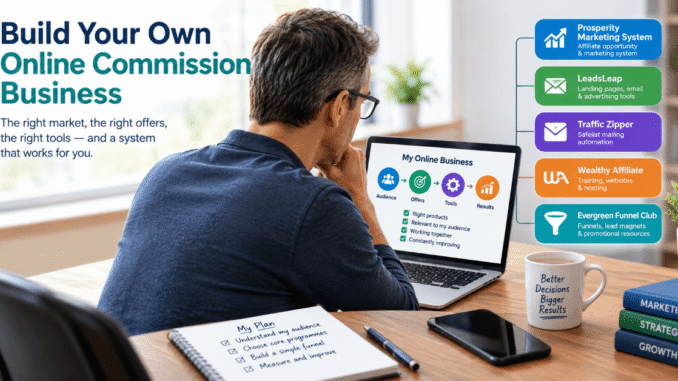
My current five are:
- Prosperity Marketing System provides a ready-made marketing and downline-building system that can be adapted to the programs you choose to promote.
- LeadsLeap provides tools for landing pages, email marketing, advertising and tracking.
- Traffic Zipper automates supported safelist mailing campaigns.
- Wealthy Affiliate provides website hosting and training for building an online business around content and affiliate marketing.
- Evergreen Funnel Club provides ready-made funnels, rebrandable lead magnets, promotional resources and training for affiliate marketers using LeadsLeap.
These programs have different roles. Some help with promotion, some with the technical side of marketing, and others with building a longer-term online presence.
I don’t expect every program to generate commissions in the same way. Nor do I assume that everyone needs all five. Someone who is just starting out may be better off learning one platform properly before adding anything else.
The point is to make deliberate choices.
Before joining another service, ask yourself three questions. What specific problem will it solve? Can it do something your existing tools cannot? And is that improvement worth the money and time involved?
If you cannot answer those questions, you probably don’t need to join just yet.
3. Look at the business as a whole, not at individual commissions
Affiliate marketing is often presented as a simple transaction. You find a product, promote your referral link and receive a commission when somebody buys.
That is how the payment works, but it doesn’t tell you whether the business behind it makes sense.
Imagine that you spend several hours promoting an offer. You generate a number of clicks, but nobody buys. You might conclude that the offer is no good, that the traffic is poor or that affiliate marketing doesn’t work.
Any of those explanations might be possible, but the clicks alone don’t tell you which is correct.
Perhaps the people visiting the page aren’t interested in the product. Perhaps the sales page doesn’t answer their questions. Perhaps your advertising attracts people who enjoy browsing but have little intention of buying.
Or perhaps you are sending visitors directly to an offer that requires more explanation than you have given them.
You need to understand the journey from the first contact to the eventual purchase before you can decide what to improve.
This is also why I pay attention to the relationship between the different parts of a business. A program that helps you attract prospects may have value even if it doesn’t pay you a direct commission for every visitor. An email service may help you follow up with people who weren’t ready to buy on their first visit. A website may allow you to publish useful information that continues attracting readers long after the original article was written.
The commercial question is whether those activities contribute to the business as a whole.
For example, if you spend £20 on advertising and earn £10 in commissions, that particular campaign has not covered its advertising cost. You would need to investigate whether the results justify further testing, taking account of any genuine future revenue that can reasonably be attributed to the campaign.
Don’t assume that a campaign will eventually become profitable just because you have built a list. Equally, don’t judge every marketing activity solely by whether it produces an immediate sale.
Measure what you can, understand the limitations of your figures and make decisions based on evidence rather than hope.
4. Make your programs complement one another
One of the most useful ideas behind Top5Programs is that the programs should make sense together.
That doesn’t mean forcing every visitor to join several services. It means understanding the different jobs involved in running an online business and choosing tools that help you perform those jobs.
Consider a straightforward example.
Suppose you publish an article about a problem that new affiliate marketers regularly encounter. The article attracts someone who wants to learn more. You offer a relevant free guide, giving the reader a reason to subscribe to your email list.
Once they have subscribed, you can deliver the guide and send further information that helps them understand the subject. If a particular service genuinely addresses a problem they have, you can introduce it in a later email or article.
The reader might decide to buy. They might not. Either way, the process gives you an opportunity to provide useful information rather than relying on a single advertisement to make a sale.
Behind the scenes, different programs can support different parts of that process. You might use LeadsLeap for the landing page and follow-up emails, Traffic Zipper to automate some promotional activity, and Wealthy Affiliate to develop your website and content skills. Evergreen Funnel Club can help when you want to use an existing funnel rather than create every component yourself.
Prosperity Marketing System offers another approach to organising your affiliate marketing activity.
There is some overlap between these services, and that is worth recognising. You don’t have to use every feature of every program, and you certainly don’t need to buy several tools that all perform the same task.
The aim is to build a workable combination, not the largest possible collection of marketing software.
It is also important to keep your recommendations relevant. Someone who subscribes to a guide about starting a blog may be interested in website hosting and training. They may have little interest in an unrelated opportunity that happens to pay a generous commission.
A connected business should make sense from the customer’s point of view, not just from the affiliate’s point of view.
5. Find the weak points and keep improving them
An online business is never entirely finished. Products change, services introduce new features, links stop working and marketing methods that once performed well may become less effective.
That doesn’t mean you need to rebuild everything every few months. It means you should know which parts of your business deserve attention.
Start with the basics.
Are your landing pages working? Do your forms accept new subscribers? Are your follow-up emails being delivered? Do your affiliate links lead to the correct destinations? Can visitors understand what you are offering and why it might be useful to them?
These checks may sound mundane, but a broken form or an incorrect affiliate link can undermine an otherwise good campaign.
Then look at performance.
If a page attracts visitors but few people subscribe, investigate the page and the relevance of the traffic. If people subscribe but rarely click your recommendations, consider whether your follow-up content is useful and whether the offers match their interests. If people click through but don’t buy, examine the offer, the audience and the information available before purchase.
None of these figures provides a complete diagnosis on its own. They do, however, give you somewhere sensible to start.
I would also distinguish between maintaining a business and constantly changing it. There is a temptation to abandon a program as soon as another one appears to offer something better. Sometimes switching is the right decision, but frequent changes can prevent you from learning what works.
Give a reasonable strategy time to produce evidence, review the results and make changes for a specific reason.
And remember to review the costs. A tool that was useful when you started may no longer justify its subscription if your needs have changed. Conversely, a service that saves you several hours of repetitive work may be worth paying for even if it doesn’t directly generate commissions.
Your job is to manage the business, not to collect tools.
Building a business you can develop over time
There is no single formula that guarantees success with affiliate marketing. Your results will depend on your market, your offers, the quality of your work, your traffic sources and a range of factors outside your control.
What you can control is how deliberately you approach the process.
Choose an audience you understand. Promote products that are relevant to that audience. Concentrate on a manageable set of programs. Pay attention to how the different parts of your business contribute to your results, and keep improving the areas that need attention.
Most importantly, build something that becomes more useful as you work on it.
An article can continue attracting readers. A useful email sequence can help new subscribers understand a subject. A well-maintained website can become a reference point for your audience. The experience you gain from testing offers and working with customers can help you make better decisions in the future.
None of this happens automatically, and there are no guaranteed commissions. But it gives your efforts a purpose beyond generating another batch of clicks.
That is what I mean by building your own online commission business.
I’ve kept Top5Programs focused on five programs that I know and use because I believe there is more value in learning how to make a sensible selection work than in continually chasing the next opportunity.
You can explore the current Top 5 programs here. Take a look at what each one offers, decide which parts of your business need the most attention, and start with the tools that make