Updated October 2026: I’ve refreshed this article to remove outdated program references and bring the advice up to date with today’s approach to blogging, targeted traffic, tracking, joint ventures and email list building.
If you’re building a home-based business online, one of your biggest challenges is finding people who are genuinely interested in what you have to offer.
You can have a great product, an attractive website and an excellent affiliate program, but none of that will help much if nobody sees your offers. You need a reliable way to attract visitors, turn some of those visitors into leads and build relationships that can eventually result in sales.
The good news is that you don’t need to invent everything yourself. There are established methods and tools that can help you build an online business without spending all your time managing the technical details.
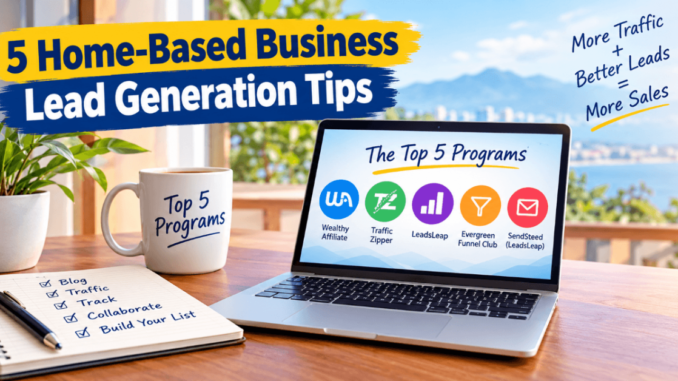
Here are five practical lead generation tips, along with examples of programs that can help you put them into action.
1. Build a Blog That Attracts the Right Visitors
A blog can be one of the most valuable assets in a home-based business. It gives you a place to publish useful information, share your experience, answer questions and introduce products or services that could help your readers.
Unlike a short-lived advertisement, a useful article can continue attracting visitors long after you’ve published it. Someone searching for a solution to a problem might discover your article through Google or another search engine, read your recommendations and decide to explore one of the products you mention.
Of course, publishing an article doesn’t guarantee traffic. You need to understand what your intended audience is looking for and create content that genuinely helps them. Product reviews, tutorials, comparisons and answers to common questions are all useful starting points.
Your blog can also work alongside other marketing channels. You might make a YouTube video about a particular topic, publish a more detailed article on your website and invite interested readers to join your email list. Each channel supports the others.
Wealthy Affiliate is one option for people who want training and website hosting in the same platform. It provides a starting point for learning how to build a website, publish content and develop an affiliate marketing business.
I’ve been a Wealthy Affiliate Premium member since 2015, and my Top5Programs.com website has been hosted there since I launched it in 2017. That experience has given me a practical appreciation of having a central website where your content and recommendations can live.
The important thing is to treat your blog as a long-term business asset. Rather than publishing nothing but affiliate links, concentrate on helping readers make informed decisions. The more useful your content is, the more reasons people have to return.
2. Get Your Offers in Front of a Targeted Audience
Having a website is one thing. Getting the right people to visit it is another.
There are many ways to generate traffic, including search engines, social media, video marketing, paid advertising, safelists and traffic exchanges. The best approach depends on the audience you’re trying to reach and the offers you want to promote.
For example, if your business revolves around affiliate marketing opportunities, list building and making money online, it makes sense to reach people who are already interested in those subjects.
This is where safelists can be useful.
Members typically send promotional emails to other members in exchange for credits or other participation requirements. The audience is already familiar with online promotions and is often made up of people marketing their own opportunities.
That doesn’t mean every member will be interested in your offer, or that every click will turn into a subscriber or customer. However, safelists give you access to an audience that is relevant to certain types of online business promotion.
One of the programs in my Top 5 is TrafficZipper, which automates mailings across supported safelist programs. If you’re using several safelists to promote your business, automation can reduce the time spent logging into individual sites and managing your mailings manually.
Instead of treating every safelist as a separate task, you can use a tool designed to help manage that part of your marketing.
Another option is LeadsLeap, which offers advertising opportunities alongside its other marketing tools. Paying Pro members receive 10 Pro Ads that can be placed in different categories within the make-money-online market.
Choosing a suitable category helps you put your advertisement in front of people whose interests are more closely aligned with your offer. Someone interested in building an email list, for example, may be a more relevant prospect for an autoresponder or traffic-generation service than someone browsing an unrelated category.
The lesson is to think about the audience before choosing the traffic source. More visitors are not necessarily better if they have little interest in what you’re promoting.
3. Track Your Results and Find Out What Works
Once you start generating traffic, you need to understand what happens next.
How many people click your advertisements? Which traffic sources bring visitors to your website? How many of those visitors subscribe to your email list? And, ultimately, which campaigns produce sales?
Without some form of tracking, it’s easy to spend time repeating activities that generate plenty of clicks but few meaningful results.
Start by measuring the things that matter to your business. If your immediate goal is to build an email list, pay attention to the number of subscribers you gain from each traffic source. If you’re promoting an affiliate product directly, look at the clicks and conversions associated with your campaigns whenever that information is available.
LeadsLeap provides tracking and other marketing tools that can help you monitor your promotional activity. You can use campaign tracking to compare results and get a better idea of which approaches deserve more attention.
Your website analytics can provide another perspective, showing how people arrive at your site and how they interact with its content.
You don’t need a complicated reporting system when you’re starting out. A simple spreadsheet recording the traffic source, campaign, clicks, subscribers and sales can be enough to identify useful patterns.
For instance, you might discover that one safelist produces plenty of clicks but few subscribers, while another produces fewer clicks but a better signup rate. That information gives you a reason to investigate the difference rather than assuming that the source with the most clicks is automatically the best.
Tracking also helps you improve your capture pages. If an advertisement attracts visitors but few people subscribe, you may need to reconsider the headline, the offer or the relationship between the advertisement and the page.
The aim isn’t to measure everything for the sake of it. It’s to learn from your results and make better decisions about where to spend your time and money.
4. Use Joint Ventures and Shared Promotional Resources
You don’t have to create every product, build every funnel or develop every promotional resource yourself.
Joint ventures and other collaborative arrangements allow marketers to work together, drawing on different skills and resources. A product creator might develop a product, an affiliate might introduce it to a suitable audience, and another service might provide tools that make the promotion easier to manage.
A practical example is the Evergreen Funnel Club, which I run to help affiliate marketers with the promotional side of their businesses.
Many digital products are launched through WarriorPlus, where product creators make their offers available to affiliates. Promoting a launch can involve preparing landing pages, writing emails, creating promotional material and arranging the follow-up needed to turn interest into sales.
Evergreen Funnel Club provides members with access to funnels and promotional resources for suitable offers, helping them avoid having to build every promotional asset from scratch. Members can use these resources to support their own marketing activities while the product creator concentrates on the product itself.
It’s an example of how different parts of the affiliate marketing ecosystem can complement one another. Product creators have offers to promote, affiliates have audiences to reach, and services such as Evergreen Funnel Club help with the practical work involved in putting a promotion together.
I’ve been involved in online business for many years, and I’ve built plenty of my own funnels. I still do that when I want something specific. However, having access to existing promotional resources can save time when they fit the offer and the audience.
You can read more about the service in my article about Evergreen Funnel Club’s monthly blog post templates.
The wider lesson is to look for opportunities to collaborate and make use of resources that already exist. You don’t necessarily need to build everything yourself to run an effective affiliate marketing business.
5. Build an Email List and Follow Up Consistently
One of the biggest mistakes a new affiliate marketer can make is relying entirely on visitors who click an affiliate link and buy immediately.
Some people will be ready to purchase when they first encounter your offer. Many others won’t. They might want to learn more, compare alternatives or wait until a later date.
If they leave your website without subscribing or otherwise giving you permission to contact them, you may have no straightforward way to continue the conversation.
An email list gives you an opportunity to build a relationship with interested prospects over time. You can share useful information, answer common questions, explain how a product works and introduce relevant offers when appropriate.
The process often begins with a capture page offering something useful in exchange for an email address. This might be a guide, a checklist, a training resource or access to a series of helpful emails.
Once someone subscribes, an autoresponder can deliver a planned sequence of messages without requiring you to send each one manually.
LeadsLeap’s SendSteed autoresponder is the tool I use as an example of this part of the process. SendSteed is the name of the autoresponder within LeadsLeap, and it can be used to organise follow-up emails for your subscribers.
A welcome message might deliver the promised resource and explain what the subscriber can expect. Subsequent emails could offer additional advice, point readers towards relevant articles or introduce products that relate to their interests.
The key is to provide value rather than bombarding people with sales messages. If every email is an attempt to make a sale, subscribers have little reason to keep reading.
Your blog and email list can support each other, too. Your blog attracts visitors and provides a place to publish useful content. Your email list allows you to bring interested subscribers back when you publish a new article, release a video or have something relevant to share.
Over time, this combination can give you a more dependable way to communicate with your audience than relying on a fresh stream of visitors every time you want to promote something.
Remember to obtain consent appropriately, follow the email marketing rules that apply to your audience and provide a clear way for subscribers to unsubscribe.
Bringing the Five Strategies Together
Lead generation isn’t a single activity. It’s a process that connects several parts of your online business.
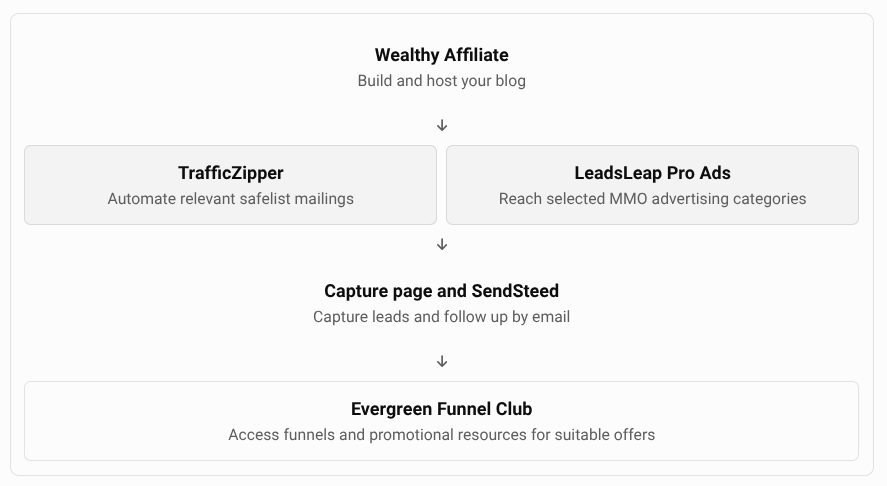
Your blog gives you a place to publish useful content. Traffic sources such as safelists and targeted advertising help you put that content and your offers in front of potential customers. Tracking shows you which activities are producing results. Joint ventures and shared promotional resources can reduce the work involved in preparing campaigns. Finally, email follow-up gives you a way to develop relationships with people who have expressed an interest in what you offer.
The five programs discussed in this article each have a role to play:
- Wealthy Affiliate provides training and website hosting for building your online presence.
- TrafficZipper automates mailings across supported safelist programs.
- LeadsLeap offers advertising, tracking and other marketing tools.
- Evergreen Funnel Club provides funnels and promotional resources for suitable affiliate offers.
- SendSteed, within LeadsLeap, helps you manage email follow-up.
You don’t necessarily need every tool from the beginning. Start with the parts of the process that address your immediate needs, learn how to use them effectively and build from there.
Most importantly, don’t confuse activity with progress. Sending thousands of advertisements or attracting hundreds of clicks doesn’t automatically produce a successful business. What counts is reaching people who are interested in what you offer, giving them a reason to engage and following up in a way that builds trust.
If you’d like to explore the five programs in more detail, visit Top5Programs.com/top-5-programs for more information.
Building a home-based business takes time, experimentation and consistent effort. With useful content, relevant traffic, sensible tracking and a way to stay in touch with interested prospects, you’ll have a much stronger foundation for developing your business over the long term.